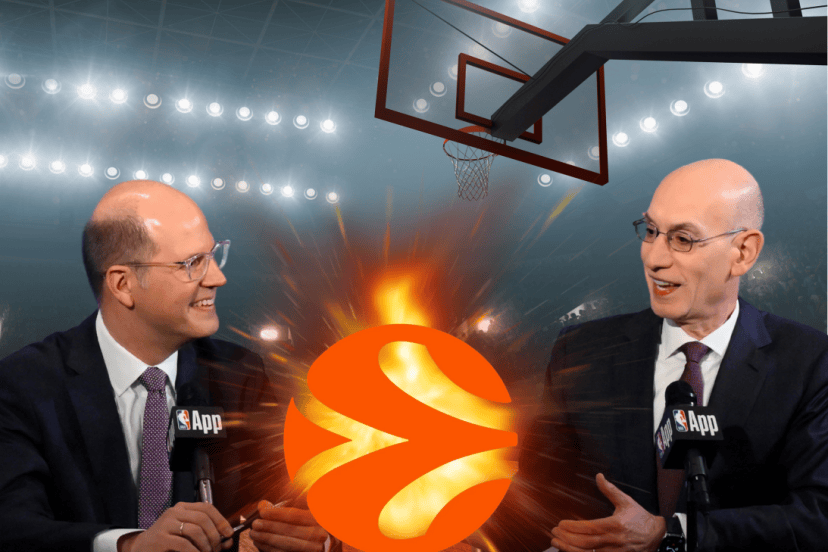
These are decisive hours for the future of European basketball. EuroLeague shareholders are meeting in Barcelona, and in the next few hours they will sit down with FIBA and the NBA. What’s going on? Let’s take stock.
Suddenly, the situation has heated up. In mid-September, NBA Commissioner Adam Silver was at best cautious about the league’s plans for a European launch: “Starting in 2027 would undoubtedly be ambitious, but I wouldn’t want to go much beyond 2028. The opportunity for such a move is now.”
In short, everything and nothing. Yet the foundations are significant. One in six current NBA players is European; Serbian star Nikola Jokić and Greek forward Giannis Antetokounmpo have won five of the last seven MVP awards; Luka Dončić and Victor Wembanyama dominate the headlines. As Silver noted: “Basketball is probably the fastest-growing sport in the world right now, and it’s the second most popular sport in Europe after football. So I think there’s a real opportunity.”
By mid-September, though, the words were still ahead of the facts. Then, out of the blue, George Aivazoglou, the NBA’s SVP and Managing Director for Europe and the Middle East, based in the league’s London office, raised the stakes.
The 1980-born executive from Thessaloniki, who grew up idolizing Nikos Galis, gave a genuine scoop to L’Équipe, dramatically upping the urgency of the moment: “The launch is set for October 2027. We are working on a league with 16 franchises, 12 permanent and 4 qualifying from other competitions, with the Basketball Champions League as the main pathway.”
To be clear, most of this had been rumored before — but moving from whispers on blogs to a major European daily is no small leap. “We take inspiration from football’s Champions League and Europa League,” Aivazoglou said. “It’s easy to understand and rewards performance on the court. We want to leave room for Cinderella stories, like Leicester’s.”
A small caveat here: Claudio Ranieri’s Leicester City famously won the Premier League, not the Champions League, where true Cinderella stories have been rare — perhaps Porto’s triumph in 2004 was the last.
Still, the message is clear: the NBA wants to build, not simply transplant. “We are still exploring different options. The simplest idea is a round-robin format, where everyone plays everyone else, followed by playoffs and finals. It is likely we’ll play under European rules, since teams will continue competing in their national leagues.”
That interview acted as a trigger — revealing and activating. For anyone who still didn’t grasp it, Hapoel Tel Aviv’s president Ofer Yannay spelled it out: “I believe NBA Europe is now at the door, and that EuroLeague is not reacting quickly enough to adapt to the changes.”
Beneath the surface, a lot is happening. Yesterday, EuroLeague shareholders met in Barcelona, and talks continued today. Tomorrow in Geneva comes the summit with the NBA at FIBA headquarters — as reported and confirmed by ROM and Sportando.
Three days of full-immersion meetings for Europe’s basketball leaders, underlining how heated the moment has become. EuroLeague simply lacks the means to fend off an NBA incursion, especially given that Real Madrid, Barcelona, Fenerbahçe, and ASVEL already appear to have one foot out the door.
Strategies are being woven; choices must be made. Or rather, shareholders must decide which shoe to put their foot in — because there won’t be enough shoes for everyone. As of today, according to our information, Greece, Serbia, and Lithuania are left out of the NBA Europe project by the league’s own design, which prefers to focus on multisport clubs already tied to football — such as Real Madrid, Barcelona, Bayern Munich, and Maccabi Tel Aviv — and to create others in new markets like the UK (London, but also Manchester and Rome), while not forgetting Berlin, Paris, and Milan.
Olimpia Milano appears to be part of this picture, as reported in recent months by reputable US sources. Whether it will join under its current ownership or in partnership with RedBird–Milan remains to be seen.
Will the cards be laid on the table tomorrow in Geneva? That’s unclear. But you don’t need to be a scientist to see that the NBA is holding the strong hand — one that could overturn the table, make EuroLeague disappear, and claim everything.
Consider the lucrative existing TV deal with Prime, the world’s leading streaming company. Or the possibility of involving a couple of European clubs in the NBA’s in-season Cup. And don’t forget that EuroLeague Basketball has generated virtually zero financial return since launching its so-called “New Era” in 2016 — which may soon become “Old.” We might find out as soon as tomorrow.


Commenta
Visualizza commenti