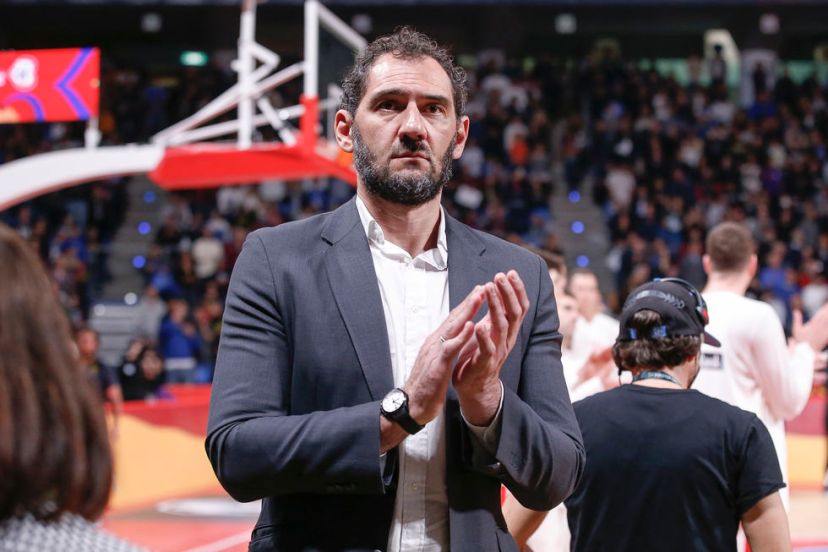
FIBA Europe president Jorge Garbajosa and executive director Kamil Novak spoke to BasketNews about the future of European basketball, the discussions with EuroLeague and the NBA, and the possibility of reaching a broader agreement between the different parties.
Jorge Garbajosa
Speaking about the current situation in European basketball, Garbajosa stressed the importance of the moment:
“We are at a crucial moment,” Garbajosa told in Beijing during the FIBA Intercontinental Cup tournament.
Garbajosa then provided some context on FIBA Europe’s discussions with EuroLeague over the past two years:
“To put some context, we have been negotiating with EuroLeague for the last two years with three different CEOs, with the intention to try to create a stable and understandable pyramid of competitions in Europe that brings benefits to all the clubs in Europe, not only for a few, and protecting the leagues, the national federations, and the national teams’ calendar also.
He then explained how the NBA became involved in the discussions and compared the approach taken with the two organizations:
“Then, for many reasons, the NBA jumped in. And what we have been asking the EuroLeague is exactly what we asked the NBA”.
According to Garbajosa, the NBA has shown an understanding of the specific characteristics of European basketball:
“And they understand and respect perfectly, since the very beginning, the values and the specific things of basketball on our continent, in our region. So that’s what makes our relationship with the NBA so close, not only for this thing, but especially in the last few months.”
Turning to EuroLeague’s position, Garbajosa emphasized that the organization is currently making its own decisions, while expressing his preference for a three-party agreement:
“About the EuroLeague, they are making their own decisions,” Garbajosa said. “Of course, I think everybody’s on the same page. Everybody wants a common, three-party agreement. It would be best if it’s doable.”
Garbajosa also clarified FIBA and FIBA Europe’s role in the discussions between EuroLeague and the NBA:
“We are not [a part] of this [discussion]; this is a bilateral negotiation between them, but as FIBA and FIBA Europe, of course, we had invited [them] to the House of Basketball [global headquarters based in Mies, Switzerland],” Garbajosa said.
He added that both organizations had been invited to meet at FIBA’s headquarters on several occasions:
“I’m talking on behalf of the Secretary General and the President, of course. But we have already invited them three times, both ECA and NBA, to try to, as Kamil said, put the distance between both organizations as close as we can”.
At the same time, Garbajosa reiterated that FIBA wants to contribute to finding a solution rather than becoming part of the dispute:
“But the negotiation is between them. Of course, we always want to be part of the solution, never part of the problem.”
Garbajosa then addressed the possibility that no agreement is ultimately reached, explaining that FIBA and the NBA have their own plans:
“At the same time, as Mr. Silver said, an agreement would be great. If not, we have our own plans to create. We had an extremely positive response from the market in Europe, above the expectations of everyone at the table. So an agreement would be nice. If not, we will go on with our program together with the NBA.
He concluded by outlining what he sees as the broader objective of FIBA Europe’s approach:
“And our goal is quite clear. It’s to move European basketball forward. I think we are the leading continent in many aspects.”
Kamil Novak
Novak then discussed the role of domestic competitions and the concerns surrounding the creation of new tournaments involving European clubs:
“Honestly, let me say, the Super Cups of the national league are extremely great tournaments and traditional tournaments for many years. And now suddenly they create a Super Cup for the benefit of a few teams or a few clubs in Europe that are playing in the Middle East. So these things don’t help.
Like Garbajosa, Novak stressed that the objective should be to reach an agreement that benefits clubs across the continent:
“But at the same time, as Mr. Silver said, and Mr. Tatum said many times, and also Mr. Bodiroga, we would like to have an agreement that benefits every club in Europe.”
Novak also revealed that an announcement regarding the markets and the 12 licenses is expected soon:
“Very soon there will be an announcement about the markets, about who will get the 12 licenses,” he told BasketNews.
He then described the response from the European market to the project as particularly strong:
“We understood that the market response was tremendous. The interest, I think, surpasses all expectations, which is interesting. It’s interesting to see that so many entities all of a sudden want to invest in European basketball.”
Novak also looked back at the previous attempts to reach an agreement, recalling that the parties had come close several times:
“Sometimes we were very close to an agreement”
He then explained that the NBA had already been invited to discussions at EuroLeague’s request:
“I remember 2-3 years ago we were very close. By the way, the NBA was invited to the talks upon the request of EuroLeague,” he added. “At the beginning of 2024, EuroLeague expressed its wish to have the NBA at the table to support its commercial activities somehow.
Finally, Novak summarized the broader objective behind the project, emphasizing the desire to create an ecosystem in which clubs can develop:
“It’s just a fact. And trying to put a very complex situation into one sentence, I would summarize it as this: we want to create an ecosystem that allows every club in Europe to grow. Step by step, they have to deserve it, but they need to feel that if they do the right thing, the correct decisions, they can grow.”


Commenta
Visualizza commenti