The jump from college to the NBA: “It’s a different world”
For a rookie, making the transition from college basketball to the NBA can be one of the biggest challenges of a young player’s career.
The speed, physicality, decision-making and overall talent level increase dramatically. Even prospects considered ready for the professional game can experience significant struggles while adjusting to the demands of the NBA.
Carter Bryant experienced that reality almost immediately.
Selected 14th overall by the San Antonio Spurs in the 2025 NBA Draft, Bryant entered the league with a reputation as an excellent defender after his time with the Arizona Wildcats.
San Antonio viewed him as a player who could eventually become an important piece of its defensive identity.
But Bryant quickly discovered that defending NBA players was a completely different challenge.
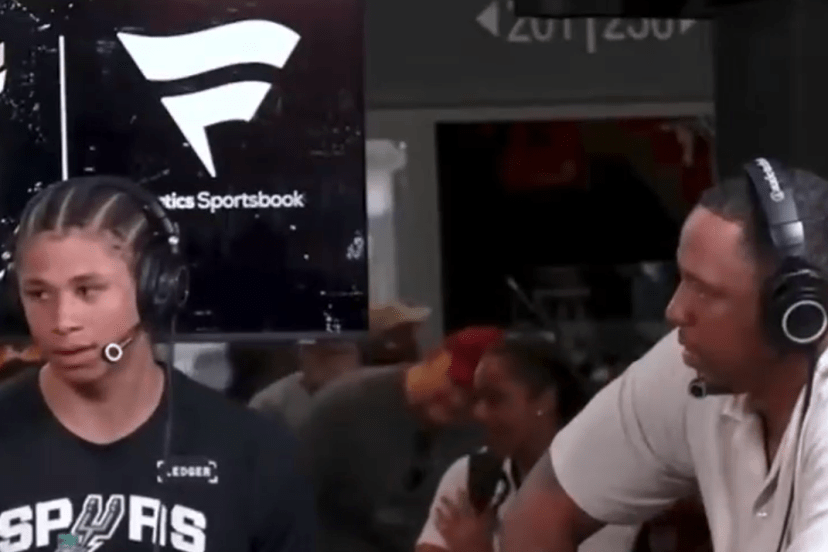
Carter Bryant telling a story about guarding Devin Vassell and getting cooked in practice:
“Coming into the league, like everybody knew me as a defender and that’s what I did. And obviously like, I carried that with me throughout my rookie year. But like I’ll never forget it was… pic.twitter.com/8cyoRhpgTJ
— NBA Courtside (@NBA__Courtside) August 11, 2026
His second day in San Antonio brought a Devin Vassell lesson
Bryant recalled one of the moments that first made him understand just how significant the jump to the NBA really was during an appearance on the Road Trippin Show podcast.
“I’ll never forget my second day in San Antonio. I was working out and I heard a ball bouncing. We have a little side room that’s reserved for shooting. I went to see what was going on, and Devin Vassell was working with our coach Jimmy Baron.”
Then came the challenge.
“Jimmy said, ‘Oh, Carter, come here. Guard Devin.'”
For Bryant, it was an immediate introduction to the level of competition he would face every day.
Vassell was already an established NBA scorer, and Bryant suddenly had to defend one of the Spurs’ most talented offensive players.
“I swear I’ve never seen a human being make that many contested shots in a row. I was playing unbelievable defense. I was thinking, ‘OK, I guess he’s going to kick my ass today, but since I’ve never done this before, I’m just going to go in and play hard.'”
The problem was that Vassell simply kept making shots.
“I promise you he probably made like 18 shots in a row on me.“
“I shouldn’t have entered the Draft”
The experience immediately affected Bryant’s confidence.
The rookie admitted that he began questioning whether he had been ready for the NBA at all.
“I was thinking, ‘Man, I shouldn’t have declared for the Draft. I’m not ready to be here.’ I was like, ‘This is serious. I don’t belong here.'”
It was a remarkable reality check for a player who had only months earlier been considered one of the more intriguing prospects in college basketball.
But Bryant’s education in the NBA was only beginning.
Then came Kelly Olynyk
Later in the season, Bryant repeatedly found himself matched up with another veteran who presented a completely different challenge: Kelly Olynyk.
The Canadian big man had already spent 13 seasons in the NBA, playing for teams including Boston, Toronto and Utah.
Bryant knew Olynyk was talented, but the rookie admitted that he had underestimated just how difficult it would be to defend him.
“You’re playing against veterans, and I didn’t know Kelly Olynyk was that good. I knew he was really good. He had some great games throughout his career in Boston, Toronto and Utah. He’s a fantastic player.“
Bryant particularly struggled when Olynyk received the ball in the post.
“When I tell you he caught it in the post, I had no idea what was happening.”
Olynyk’s combination of footwork, shooting ability and creativity constantly forced the rookie to react.
“He’d do one-legged step-backs, he’d give me a pump fake, and then he’d score off the glass. He was having fun with me.“
Even the coaches were getting on Bryant
The struggles against Olynyk did not go unnoticed by the Spurs coaching staff.
Bryant recalled having coaches constantly challenging him during practices.
“I had all the coaches on me. They were like, ‘Hey, you’re supposed to be a defender. It looks like you don’t belong here.'”
Those experiences naturally affected his confidence.
“I remember my first two weeks guarding Kelly. It was horrible for me.“
For a first-round pick who had built his reputation around defense, being repeatedly exposed by experienced NBA players was a significant challenge.
But it also became one of the most valuable parts of his rookie education.
Bryant kept working and earned opportunities
Despite those difficult moments, Bryant did not allow the early struggles to define his season.
He continued to rely on the qualities that had made him an attractive prospect in the first place: energy, physicality, defensive intensity and a willingness to compete.
That work eventually earned him the trust of Spurs coach Mitch Johnson and a place in San Antonio’s rotation.
Bryant appeared in 71 regular-season games during his rookie campaign, averaging 11.5 minutes, 4.2 points and 2.5 rebounds per game.
Those numbers reflected a player still adapting to the NBA, but they also demonstrated that San Antonio was willing to give its young forward meaningful opportunities.
Bryant also gained playoff experience
The rookie also saw action during the Playoffs.
As the Spurs advanced deeper into the postseason and eventually reached the NBA Finals, however, Bryant’s role became smaller and his appearances were increasingly limited.
Still, experiencing a deep playoff run during his first NBA season provided valuable exposure to the intensity and demands of postseason basketball.
Bryant’s rookie year therefore offered two very different lessons: the NBA was much harder than he had imagined, but the struggles themselves became part of his development.
The biggest lesson
The experiences against Vassell and Olynyk demonstrate just how difficult the transition from college basketball to the NBA can be, even for a highly regarded first-round pick.
Bryant arrived in San Antonio with the reputation of being an elite college defender. But he quickly learned that being a good defender at the NCAA level is only the starting point in the NBA.
Players are faster, stronger and more skilled, while veterans know how to exploit even the smallest defensive mistake.
Bryant’s first weeks were, in his own words, “horrible.” But those experiences also taught him exactly what he needed to improve if he wanted to establish himself at the highest level.
The rookie got his reality check early. The next step is turning those lessons into the foundation of a long NBA career.


Commenta
Visualizza commenti