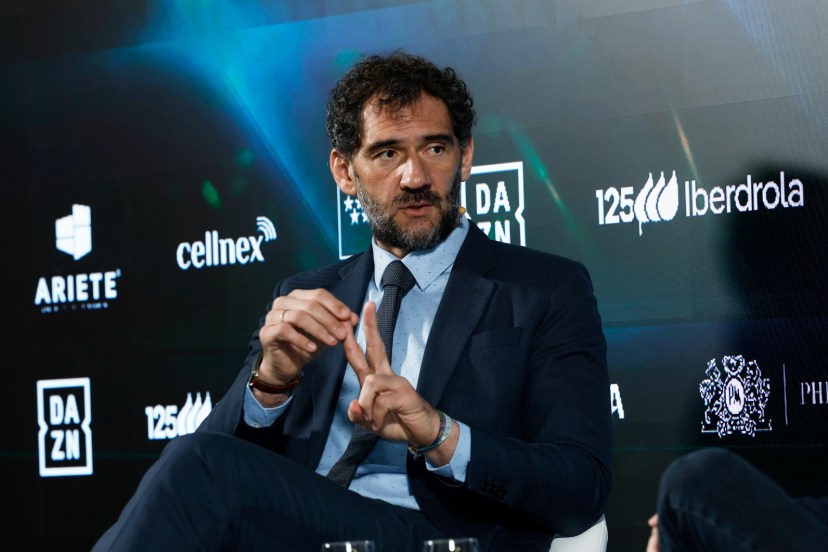
The FIBA Europe president Jorge Garbajosa discusses the project at the MARCA Expansion Business Forum: 16 teams, sporting merit and a focus on financial sustainability.
“To get straight to the point, I find it amusing that all of this is being presented as a revolution, because in reality we are going back to the roots of sport and its competitions. Sometimes people try to create the idea that this is a new competition driven by a power struggle or a fight over territory. What we are talking about is relaunching European basketball, both at club and national-team level. We all have to accept our share of responsibility for what has been done well and, above all, for what has been done poorly over the last 25 years. When you have a competition aiming to determine the future of an entire sport through just 12 clubs, the international federation and the national federations cannot agree with that approach. I did not agree with it when I was president of the Spanish Basketball Federation, and I do not agree with it now. We are talking about something supposedly revolutionary: the idea that whoever wins a national championship in Europe, whether in Spain, Italy, Greece or Turkey, qualifies for the top European competition. That doesn’t sound unreasonable, does it? And yet, basketball does not work that way today. This new competition is just the tip of the iceberg of something much bigger.”
“We want to restore principles that already work in football, handball and volleyball. The figures and levels of investment tell us that the current system is not working. We spent two years negotiating with EuroLeague and proposed three principles. The first was respecting the national-team calendar. We are talking about four games during the season: two in November and two in February. The second was that national leagues should guarantee access to European competitions. The third was to work together to build a pyramid of competitions that fans and players themselves can understand. We were unable to reach an agreement, and I accept our share of responsibility for that. Then the NBA came along and told us that it respected all three principles. If I want to invest in a team in Torrejón de Ardoz, the city I come from, why should I do so if, no matter how well I manage it, how much I invest or how patient I am, I will never be able to compete in the top international competition? The NBA said it wanted to open up that competition through its brand, its experience and sporting merit. And when you hear about a meeting in London with as many as 100 investment funds, that is no coincidence.”
“We have normalized a situation in which clubs operating with public budgets accept losses of around 50%. The NBA has been generating billions in profits in the United States for decades, benefiting both franchise owners and the competition itself. And that translates into a better show for fans and better contracts for players. What we want is to improve basketball as a whole. We need to offer fans an experience they can enjoy with their families, one that can compete with other forms of entertainment. And if you add the NBA’s track record, having built one of the most profitable sports competitions in the world, I think we can give it the benefit of the doubt.”
“One thing we discussed with the European Commissioner for Sport [Glenn Micallef, ed.] is that 95% of that investment will remain in Europe. There will be capital coming from within Europe and from abroad, managed by people with proven experience. All the NBA had to do was express an interest in Europe for the conversation to shift from losses to who can generate the greatest profits. Investors have identified a business opportunity. On one side, there is a brand that knows how to run basketball profitably. On the other, there are European leagues facing financial difficulties. Here in Spain, the ACB is doing relatively well. But there are leagues struggling to find a main sponsor and to grow. We keep doing the same things even when we see that they are not working. In the United States, despite operating in a very competitive market, different sports and organizations coordinate their schedules to avoid overlaps during major events. The NBA, for example, makes room for the college basketball championship game. They understand that generating business is good for the sports industry as a whole. And the NBA has spent decades expanding internationally, particularly in Asia and Europe, and now also in Africa together with FIBA. The same players will play and the same coaches will coach. We want them to do so under better conditions and for this growth to benefit everyone.”
“I find it amusing that London seems exotic to us when, just a month ago, we saw a EuroLeague Super Cup in Abu Dhabi, with Dubai taking part, at a time when national leagues are traditionally being played. To me, it seems much more natural for London to play in Europe. The move towards the Middle East is driven by the search for financial resources.”
“Building a competition from scratch, at the level we are aiming for, takes time. We have already spoken with the Basketball Champions League clubs, with the NBA present, to explain the next steps. The idea is that teams can reach NBA Europe both through their national leagues and through the BCL. The FIBA Europe Cup would constitute the third tier, offering opportunities to countries whose clubs have fewer chances to compete in Europe. Once they enter the system, despite the obvious competitive difficulties, they will have a pathway to the top competition. There will be 12 franchises and four teams qualifying on sporting merit. While those four teams compete in the tournament, they will receive the same revenues and have the same rights and the same financial obligations as the franchises.”
“When will the teams be announced? It depends on the NBA. We believe it will happen before the end of the year or at the beginning of 2027.”
“There are two essential groups in this industry: players and fans. We have to take care of the players. You cannot expect them to play three or four highly competitive games a week, with all the travel that entails, and still deliver a great show every time. From the very first game of the Liga Endesa, teams are already fighting to qualify for the Copa del Rey, avoid relegation or achieve whatever objective the club has set for itself. That is why we need a unified calendar. And fans need to understand what they are watching and what is at stake for their team. I remember the son of a friend of mine, who supports Real Madrid. He had watched a fantastic game, full of tension. Madrid lost and he was upset. But shortly afterwards he said: ‘Well, never mind. It doesn’t really matter anyway.’ That does enormous damage to our sport. Every game must matter. National leagues are like the home-cooked meal you enjoy every day. Then you have to earn the right to go out for dinner, meaning competing internationally.”
“I wonder why EuroLeague is working on its plan that projects 2.4 billion euros in profits right now, after 26 years. We are talking about a basketball ecosystem that is losing money and suddenly they tell us that money is going to rain down. I want to see it happen. Nobody has explained to me how. The figures surprise me, as does the fact that they are being announced just as the NBA decides to enter Europe. We tried to establish a three-way agreement covering calendars, competition and the commercial side. That was not possible either. FIBA has a mandate from its governing bodies to improve basketball as a whole. So far, the figures suggest that EuroLeague’s existing model has not achieved that. I find it surprising that it will suddenly manage to do so now.”
“We talk about sporting merit, and then we see five-year contracts being offered. One club received such an offer, and you have to wonder what would have happened if it had accepted and then been relegated. It is November and, without this new project, I could already tell you which teams will play in Europe next season. Fans want to know who will win, who will struggle and who will be the surprise. For an investor, it also makes an enormous difference to have a place in the competition guaranteed in advance. I have an extraordinary personal relationship with the president of EuroLeague and excellent relationships with many clubs and league presidents. But every time it seems that we are close to an agreement, it never materializes. The three principles we presented to EuroLeague are exactly the same three principles we presented to the NBA.”
“Approximately 600 clubs effectively have the opportunity to reach NBA Europe. They have to earn it. That is the essence of sport.”
“We are coming from a model with 13 permanent places plus another six, with a possible expansion to 24 teams, without taking national leagues into account. Our idea is that, at the end of the season, the highest-ranked teams that are not franchises will face each other in qualifying tournaments to earn a place. These will be win-or-go-home games, with the opportunity to play in the top European competition at stake. This also attracts casual fans and can generate revenue to be distributed to help the sport grow.”
“Launching in 2027 is difficult. It is a challenge. Would I like it to happen? Yes. Would I lose sleep if we had to postpone it by a few months? No. What matters is making it happen. And even before it has started, it has already changed the landscape. The CEO of RedBird Capital, which owns AC Milan [Gerry Cardinale, ed.], has spoken about building an arena and investing. We are talking about a major investment fund in the sports sector that had not shown any interest in basketball until now. We are already discussing investments worth billions.”
“Many EuroLeague clubs are willing to join NBA Europe. At some point, all of them have said they are open to talking. Changing competitions takes time. At one point, they wanted to negotiate collectively. That is where the Lake Como proposal that leaked to the press came from. Then each club’s position changes depending on the offer and its individual situation. But every one of them has started discussions.”
“Imagine Unicaja winning the Liga Endesa and qualifying for that competition. It could be Unicaja, Ulm in Germany, Luis Scola’s Varese in Italy or Marc Gasol’s Girona. I would like investors to recognize that basketball represents a business opportunity. Under the current EuroLeague model, some clubs are supported by football organizations, while others rely on wealthy benefactors, such as Panathinaikos or Valencia. I have the utmost respect for those who invest their own money. What I want is a sustainable model in which Europe’s biggest clubs continue to have the prominence they deserve, but in which everyone else knows that, if they invest and work well, they can earn a place at the same table. And once they get there, they will compete under the same financial conditions. If, in September, you still do not know which teams will play in Europe the following season, the stakes in national leagues become much higher. This creates visibility and can attract investment.”
“As a former player, I want athletes to earn more. I think I was born too early [laughs, ed.]! They are the ones who make all of this possible, putting their bodies and their reputations on the line every day. But an inflated market is harmful. Limiting spending to a percentage of revenue seems sensible to me. It could help prevent situations like the one that happened in Monaco. You enter a race to raise the competitive level, the market becomes inflated and, when the money runs out, the contracts remain in force. What happens when a wealthy benefactor gets tired of funding a club, or when a football club decides to stop investing in basketball? The model is truly at risk if we do not make it sustainable.”
“The competition will always be played during the week. For us, that is a must. We will try to reduce the number of games. And it has already been agreed that NBA Europe will stop in November and February for the national-team qualifying windows. That is set in stone.”
“We brought EuroBasket forward by a few days at EuroLeague’s request. It is an agreement based on mutual concessions. They needed more dates to organize their competition, and for us the sixth qualifying window, which determines qualification for the World Cup, is essential. I appreciate that we managed to reach this agreement and that both sides understood the other’s position. But we cannot spend every year wondering whether we are getting along better or worse.”


Commenta
Visualizza commenti